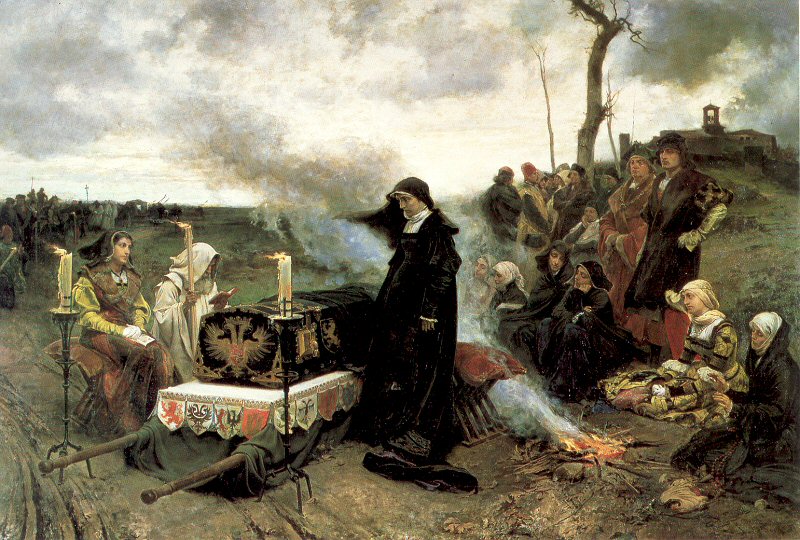
Juana aka Juana la Loca, or Juana the Mad was born on 6, November 1479. Though she led a tortured existence, she would live until age 75. That Juana lived to such an advanced age is remarkable, given the time she lived in, the then predicted life-span, and the miseries she endured.
Juana was about as unlucky in love and life as a woman could be. To date, Juana remains one of the most tragically misunderstood figures of her time.
Born in Toledo, capital of the Kingdom of Castile , she was the third daughter of Isabella 1 of Castile, and Ferdinand II of Aragon, from the House of Trastamara. Juana showed great promise as a child, and actually mastered all of the Iberian Romance languages, as well as being fluent in both French and Latin. Juana was considered exceptionally attractive as a child. Though nearly always portrayed on film by women with olive features, Juana had the same coloring as her mother, and sister Catherine of Aragon, with strawberry blonde hair and pale blue eyes, of fair complexion. Though Juana was not expected to reign, she gave every impression of having a bright future. No one could have predicted the profound sadness and instability that would plague Juana later.
1496 was a year Juana would always remember, as she was betrothed to Phillip the Handsome, in Flanders. The two attractive youths were instantly smitten. However, Joanna's sublime feeling would be fleeting, due to Phillip's infidelities, and extreme political pressures placed upon the young couple. The concept of marital fidelity was much lauded in this age, but for male monarchs was hardly a realistic one. Though the knowledge that one's husband is cheating is, and has always been painful for a woman, Juana's heartache would come to define her. The unhappy young wife grew obsessed with her husband, and his mistresses. Sick with jealously and depression, Juana grew increasingly unstable. Others would take advantage Juana's obvious vulnerability, and when her husband died on 25, September 1506, it was a devastating blow from which she would never recover from. Phillip had been only 28 years old at the time of his death. Circumstances surrounding the death were both mysterious and disturbing, adding to Juana's misery.
Juana's life eventually deteriorated to the extent that her own son virtually imprisoned her. Isolated and cast aside, Juana was left with little more than her memories.
27 January 2011
26 January 2011
Queen Claude of France: a picture of humility
Queen Claude was the wife of the flambouyant Francis 1 of France. Claude lived a life marked by difficulty and extremely poor health. Queen Claude spent much of her short life pregnant, actually every year after her marriage to Francis, when she was only 14 years old. The queen would bear seven children to Francis, and die at the age of 24.
Claude was described by contemporary reports as homely, and deformed. But what she lacked in outer beauty was perhaps made up for by her good character. The young queen suffered from severe scoliosis and was of short stature. Claude was reported to have had a warm, gentle nature, but was hemmed in by a rather claustrophobic existence, to say the least.
Although there exists no hard evidence to prove such: it is commonly believed that Anne Boleyn spent at least 7 years in Queen Claude's household. Claude spent most of her time in the beautiful Upper Loire, and at Blois. Anne reportedly adored the French ambiance and sophisticated culture. Anne was truly in her element. She would so adapt herself to the French court, that in England, years later Anne was often mistaken for a natural born Frenchwoman. It is believed that Anne honed her remarkable singing and musical skills while in service in Claude's household.
While Claude endured one difficult pregnancy followed by another, her husband also had a serial pastime, but his was with mistresses. Claude bore his infidelity with stoic silence, choosing to concern herself with her own personal spirituality, and virtue. Though gentle by nature, Claude ran a famously strict household, and most people in her service would abide to her standards. Though physically frail, Queen Claude was not weak in character.
Claude's death on 20, July 1524, would have an obvious demoralizing effect on Francis and his court, and syphilis is thought to be the actual cause of his own death in 1547. Despite the lack of fidelity Francis had demonstrated while his dutiful wife lived, he would mourn her death heavily, probably realizing all that he had lost when his young wife quietly departed.
Claude was described by contemporary reports as homely, and deformed. But what she lacked in outer beauty was perhaps made up for by her good character. The young queen suffered from severe scoliosis and was of short stature. Claude was reported to have had a warm, gentle nature, but was hemmed in by a rather claustrophobic existence, to say the least.
Although there exists no hard evidence to prove such: it is commonly believed that Anne Boleyn spent at least 7 years in Queen Claude's household. Claude spent most of her time in the beautiful Upper Loire, and at Blois. Anne reportedly adored the French ambiance and sophisticated culture. Anne was truly in her element. She would so adapt herself to the French court, that in England, years later Anne was often mistaken for a natural born Frenchwoman. It is believed that Anne honed her remarkable singing and musical skills while in service in Claude's household.
While Claude endured one difficult pregnancy followed by another, her husband also had a serial pastime, but his was with mistresses. Claude bore his infidelity with stoic silence, choosing to concern herself with her own personal spirituality, and virtue. Though gentle by nature, Claude ran a famously strict household, and most people in her service would abide to her standards. Though physically frail, Queen Claude was not weak in character.
Claude's death on 20, July 1524, would have an obvious demoralizing effect on Francis and his court, and syphilis is thought to be the actual cause of his own death in 1547. Despite the lack of fidelity Francis had demonstrated while his dutiful wife lived, he would mourn her death heavily, probably realizing all that he had lost when his young wife quietly departed.
Queen Catherine gives birth to Mary
Mary was born on 18, February 1516. She was Monday's child, born in the early hours of the morning. Queen Catherine had endured a very difficult labor, and was undoubtedly hoping for a healthy baby boy. Catherine would not have her heart's desire, as the baby was a girl. She was also unaware that much sadder news awaited her. Two days prior, news had arrived in London bearing the notice that Catherine's beloved father had died. This news was deliberately kept from her, understandably, that she might face her labor and delivery in as good form as possible.
Catherine had endured much heartache, and great disappointment prior to Baby Mary's birth. Catherine had suffered four miscarriages, a stillbirth, and the mysterious death of a seemingly healthy baby son at the age of two months. It must be remembered that while Catherine was experiencing her long series of disappointments, she was also growing older. There clock ticked loudly for Tudor women, much more so than for women in their childbearing years, today. Life expectancy was much reduced, and therefore the time to easily conceive was shortened accordingly. There were still instances of women delivering viable infants in their mid-forties, or so, but these cases were rare.
Though Henry was disappointed at Mary's gender, he adopted a positive outlook, saying that her birth was proof that the couple could have healthy children. "We are still young," Henry replied to a Venetian ambassador who had offered what could nearly be taken as a condolence.
Henry may have been too optimistic. Catherine was 31, and in Tudor days, a number of years which we now regard as youthful, was actually quite mature.
Catherine had endured much heartache, and great disappointment prior to Baby Mary's birth. Catherine had suffered four miscarriages, a stillbirth, and the mysterious death of a seemingly healthy baby son at the age of two months. It must be remembered that while Catherine was experiencing her long series of disappointments, she was also growing older. There clock ticked loudly for Tudor women, much more so than for women in their childbearing years, today. Life expectancy was much reduced, and therefore the time to easily conceive was shortened accordingly. There were still instances of women delivering viable infants in their mid-forties, or so, but these cases were rare.
Though Henry was disappointed at Mary's gender, he adopted a positive outlook, saying that her birth was proof that the couple could have healthy children. "We are still young," Henry replied to a Venetian ambassador who had offered what could nearly be taken as a condolence.
Henry may have been too optimistic. Catherine was 31, and in Tudor days, a number of years which we now regard as youthful, was actually quite mature.
25 January 2011
Sad Christmas of 1531
Christmas of 1531 was considered to be one of the saddest the court had seen. While Henry tried to present a picture of merriment and mirth, his efforts did little to dispel the gloom. Queen Catherine and her ladies were conspicuously absent. In the mind of the English people, Anne Boleyn would never serve as a satisfactory substitute for their beloved queen. In Rome the process of the divorce was in a certain downward spiral. Anne Boleyn had strong influence whilst she was at Henry's side, but she was also resented, even hated by a growing number of the English people.
Tradition held that on New Year's Day, gifts were to be exchanged amongst the royal court. Anne presented Henry with Pyrenean boar spears, and Henry gave Anne luxurious embroidered crimson, and hangings in cloth of gold, and of silver. These lovely gifts could not, however, erase the feelings and mood that resulted from Henry's decision to exclude Catherine from the holiday proceedings. It was the first time the king would not give any holiday gift to his queen, and hatefully, he also demanded that no courtier would make a gift to Catherine. Embarrassingly for Henry and Anne, Catherine did remember Henry with a gift: a remarkable gold cup, obviously expensive and very fine. The king was obviously blindsided by the unexpected gift, and took out his rage on the poor gentleman of the privy chamber. Almost immediately afterward, in a panic, Henry realized he had made a foolish mistake in rejecting the gift. If the beautiful cup had already been sent back, there was every possibility that it would be presented again at a public court function, where Henry could not possibly reject it and thus be forced to recognize his relationship with Katherine.
No one could ever accuse Katherine of having a lack of intelligence, and in this case she had shown a sharp cleverness. As things turned out, the cup had not yet been returned, and Henry issued orders that it not be returned until that evening.
King Henry's uneasiness and Anne's growing sense of anxiety would have been palpable that Christmas of 1531.
Tradition held that on New Year's Day, gifts were to be exchanged amongst the royal court. Anne presented Henry with Pyrenean boar spears, and Henry gave Anne luxurious embroidered crimson, and hangings in cloth of gold, and of silver. These lovely gifts could not, however, erase the feelings and mood that resulted from Henry's decision to exclude Catherine from the holiday proceedings. It was the first time the king would not give any holiday gift to his queen, and hatefully, he also demanded that no courtier would make a gift to Catherine. Embarrassingly for Henry and Anne, Catherine did remember Henry with a gift: a remarkable gold cup, obviously expensive and very fine. The king was obviously blindsided by the unexpected gift, and took out his rage on the poor gentleman of the privy chamber. Almost immediately afterward, in a panic, Henry realized he had made a foolish mistake in rejecting the gift. If the beautiful cup had already been sent back, there was every possibility that it would be presented again at a public court function, where Henry could not possibly reject it and thus be forced to recognize his relationship with Katherine.
No one could ever accuse Katherine of having a lack of intelligence, and in this case she had shown a sharp cleverness. As things turned out, the cup had not yet been returned, and Henry issued orders that it not be returned until that evening.
King Henry's uneasiness and Anne's growing sense of anxiety would have been palpable that Christmas of 1531.
Catherine of Aragon: Womanly virtues
Queen Catherine was the quintessential woman, monarch, and wife. (Did you hear that Henry?) Catherine was a woman who held to her virtues in the face of incredible rejection, and a long series of personal heartbreaks.
Catherine was loved by the English people from start to finish. Most modern portrayals of Catherine feature women with dark eyes and raven locks. As stunning as those features are, Catherine in no way resembled such a woman. Catherine of Aragon had luxurious strawberry blonde hair, and pale blue eyes. She was of a fair complexion with a rose to her cheeks. Catherine had a buxom figure, and after many pregnancies her figure was rather fulsome.
The lonely queen's life was anything but easy, and she experienced a long series of health problems and depression. How much of her sufferings were caused by her genetics, or the incredible stresses she endured in England are hard to gauge.
Catherine's life was nearly unbearable in the time after Arthur's death and up until her marriage to Henry. There would be some happiness, followed by years of sorrow. Even so, Catherine remained a kindly woman, one who chose to pardon her enemies. Some have criticized her harshly for refusing to let go of the king when he decided he would have Anne Boleyn as his wife. It may have been immeasurably better had she released her husband rather than oppose the divorce in a schism that cracked England in two. But her reasoning was that her husband's soul was in danger if he persisted with the divorce and eventual remarriage to Anne.
Catherine's personal symbol was the pomegranate of Granada. Palace walls were embellished with Tudor roses, pomegranates, and the initials H for Henry, and K as then Catherine's name was usually spelled as Kateryne by the English people.
Catherine's natural beauty would fade relatively early. Contemporary reports record that she had very unusual, and unhealthy eating habits. Despite her stoutness, gluttony was not her problem. Rather, she seemed to eat too sparingly, and with little dietary variety. The queen was also in a more often than not constant state of pregnancy. Catherine also had to worry early on about Henry's marital fidelity, or lack of. Catherine was only 29 when the cracks in her marriage were beginning to show. To the queen, her identity as wife and mother was her very essence. And it is not difficult to understand how the stress she endured rapidly evidenced itself on the long-suffering queen's once cherubic face.
Catherine was loved by the English people from start to finish. Most modern portrayals of Catherine feature women with dark eyes and raven locks. As stunning as those features are, Catherine in no way resembled such a woman. Catherine of Aragon had luxurious strawberry blonde hair, and pale blue eyes. She was of a fair complexion with a rose to her cheeks. Catherine had a buxom figure, and after many pregnancies her figure was rather fulsome.
The lonely queen's life was anything but easy, and she experienced a long series of health problems and depression. How much of her sufferings were caused by her genetics, or the incredible stresses she endured in England are hard to gauge.
Catherine's life was nearly unbearable in the time after Arthur's death and up until her marriage to Henry. There would be some happiness, followed by years of sorrow. Even so, Catherine remained a kindly woman, one who chose to pardon her enemies. Some have criticized her harshly for refusing to let go of the king when he decided he would have Anne Boleyn as his wife. It may have been immeasurably better had she released her husband rather than oppose the divorce in a schism that cracked England in two. But her reasoning was that her husband's soul was in danger if he persisted with the divorce and eventual remarriage to Anne.
Catherine's personal symbol was the pomegranate of Granada. Palace walls were embellished with Tudor roses, pomegranates, and the initials H for Henry, and K as then Catherine's name was usually spelled as Kateryne by the English people.
Catherine's natural beauty would fade relatively early. Contemporary reports record that she had very unusual, and unhealthy eating habits. Despite her stoutness, gluttony was not her problem. Rather, she seemed to eat too sparingly, and with little dietary variety. The queen was also in a more often than not constant state of pregnancy. Catherine also had to worry early on about Henry's marital fidelity, or lack of. Catherine was only 29 when the cracks in her marriage were beginning to show. To the queen, her identity as wife and mother was her very essence. And it is not difficult to understand how the stress she endured rapidly evidenced itself on the long-suffering queen's once cherubic face.
23 January 2011
Pregnancy & Childbirth: Tudor style
The experience of pregnancy and subsequent childbirth, has never been easy, as women all the way back to Mother Eve can attest to. While the maternal state is a natural condition for women, it has always posed some degree of danger to mother and baby. While the danger is reduced in this modern era, there still exists a small percentage of women who die due to complications of pregnancy and/or childbirth. While the danger is now much reduced in our industrialized societies, there is still viable risk to mother and baby. This is simply an inherent element of bearing children. The dangers to women and infants who live in 3rd world societies remain unacceptably high.
The mortal risk that maternity carried in Tudor days was certainly significant. Were it not bad enough that medicine was comparatively, in a dark age, it was coupled with superstitious myths and beliefs that increased peril faced by mothers and infants. There are records of Tudor women so thoroughly terrorized by the prospect of dying in childbirth, that they simply elected to avoid marriage. Queen Elizabeth was thought to have a strong fear of childbirth, though the reasons for her firm avoidance of marriage are not clear, and seem to have been complex. *(No doubt that having witnessed firsthand her sister's horrifying experience with two hysterical pregnancies did little to sweeten Elizabeth's views on the matter of childbearing.)
For Tudor women, the experience of childbearing was one that might cause elation for one woman, and abject misery for her neighbor. There existed no reliable tests to determine if a woman were pregnant, or not. Housewives' tales abounded, such as the belief that the veins beneath a pregnant woman's tongue would be greenish in hue. Strong food cravings were also thought to be related to pregnancy, as they still are today. Prenatal care was virtually non-existent. Tudor women followed a very odd dietary regimen prescribed by the physicians and midwives of the day. A strange but common belief at the time was that pregnant women should carefully avoid viewing, or even thinking about any disturbing subject. Having suffered a fright or disturbance during pregnancy was thought to cause monstrous births, that is delivery of a severely deformed child. One can only imagine the sorrow of women who were unfortunate enough to have delivered such children, given the ignorance and lack of empathy of the times. Worse, such mothers were often accused of being evil, or at blame somehow for such a birth. Women were often held responsible for the very sex of their infant, a woman being a "good wife" for birthing sons, and by contrast a "bad wife" who only brought her husband daughters. One famous example of this cruel, misogynistic attitude is that of King Henry VIII, and his severe displeasure when Anne Boleyn found herself unable to give her husband a son.
The number of children desired by Tudor women was usually related to socioeconomic status. Wealthier families were typically desperate to product mail heirs; poor families often experienced severe anxiety and deprivation with each new addition to the family.
Pity the poor woman who became pregnant outside of marriage in those days, as she would be heavily sanctioned by her community, and often her family as well. An unmarried mother might have to rely solely on the church for support, and this inevitably resulted in bad feelings across the board.
Though the majority of pregnancies in Tudor times did result in delivery and live birth, women dying in childbirth was not a rare occurrence. The majority of women knew, or even witnessed a women who had died in her child-bed, and due to lack of effective medical intervention, those deaths were often prolonged and painful.
Queen Jane Seymour was one such woman who would die of complications related to childbirth. After an excruciatingly painful labor lasting days, and finally culminating in the birth of Edward, in 1537, Queen Jane would die of child-bed fever shortly afterward.
The mortal risk that maternity carried in Tudor days was certainly significant. Were it not bad enough that medicine was comparatively, in a dark age, it was coupled with superstitious myths and beliefs that increased peril faced by mothers and infants. There are records of Tudor women so thoroughly terrorized by the prospect of dying in childbirth, that they simply elected to avoid marriage. Queen Elizabeth was thought to have a strong fear of childbirth, though the reasons for her firm avoidance of marriage are not clear, and seem to have been complex. *(No doubt that having witnessed firsthand her sister's horrifying experience with two hysterical pregnancies did little to sweeten Elizabeth's views on the matter of childbearing.)
For Tudor women, the experience of childbearing was one that might cause elation for one woman, and abject misery for her neighbor. There existed no reliable tests to determine if a woman were pregnant, or not. Housewives' tales abounded, such as the belief that the veins beneath a pregnant woman's tongue would be greenish in hue. Strong food cravings were also thought to be related to pregnancy, as they still are today. Prenatal care was virtually non-existent. Tudor women followed a very odd dietary regimen prescribed by the physicians and midwives of the day. A strange but common belief at the time was that pregnant women should carefully avoid viewing, or even thinking about any disturbing subject. Having suffered a fright or disturbance during pregnancy was thought to cause monstrous births, that is delivery of a severely deformed child. One can only imagine the sorrow of women who were unfortunate enough to have delivered such children, given the ignorance and lack of empathy of the times. Worse, such mothers were often accused of being evil, or at blame somehow for such a birth. Women were often held responsible for the very sex of their infant, a woman being a "good wife" for birthing sons, and by contrast a "bad wife" who only brought her husband daughters. One famous example of this cruel, misogynistic attitude is that of King Henry VIII, and his severe displeasure when Anne Boleyn found herself unable to give her husband a son.
The number of children desired by Tudor women was usually related to socioeconomic status. Wealthier families were typically desperate to product mail heirs; poor families often experienced severe anxiety and deprivation with each new addition to the family.
Pity the poor woman who became pregnant outside of marriage in those days, as she would be heavily sanctioned by her community, and often her family as well. An unmarried mother might have to rely solely on the church for support, and this inevitably resulted in bad feelings across the board.
Though the majority of pregnancies in Tudor times did result in delivery and live birth, women dying in childbirth was not a rare occurrence. The majority of women knew, or even witnessed a women who had died in her child-bed, and due to lack of effective medical intervention, those deaths were often prolonged and painful.
Queen Jane Seymour was one such woman who would die of complications related to childbirth. After an excruciatingly painful labor lasting days, and finally culminating in the birth of Edward, in 1537, Queen Jane would die of child-bed fever shortly afterward.
Queen Mary 1: Dark days and disturbances
It is fairly incredible that so little is actually known about the infamous queen, Mary 1 of England. That is, relatively speaking. An example is the photo at right; some say it is an image of Queen Mary 1; others claim it is Margaret Douglas. Personally, I lean toward Margaret, but the heavy black dress and style, and are certainly the essence of Mary 1.
One of the strangest and most disturbing aspects of Queen Mary 1's whole persona, other than the most obvious, the Marian Persecutions, are her history of phantom pregnancies. Even today this strange malady is hotly debated, even to the extent of whether or not the state of phantom pregnancy actually exists. What is known is that Mary believed she was with child at least twice, and that she exhibited strong symptoms of actual pregnancy. The supposed causes of her phantom pregnancies are unknown, and almost certainly will remain thus.
As of late, revision writers, some of them truly gifted, are hard at work in an attempt to paint Mary in a new light. Though I find their writings to be endlessly fascinating, I am unsure as to how we might view Mary more favorably, as it is a documented fact that she was responsible for sending over 300 human beings to the stake. Her very name is synonymous with terror and religious persecution: Mary Tudor.
Those who are sympathetic of Mary Tudor inevitably cite her bitter childhood and adolescence in portraying her more positively. I digress; who can say they are not personally acquainted with a friend or family member who has experienced a miserable childhood? What percentage of the population has experienced the rejection of a parent? Unfortunately, this is not a rare or uncommon occurrence. Not withstanding, only a small number of people who have experienced such tragedy will every display the cruel malevolence that Mary did. Granted that few people will ever hold the power to exact such revenge on society. None the less, her actions live on, nearly half a millennium after her death.
Mary's phantom pregnancies were as mysterious as they were personally humiliating. What is known is that she was likely too advanced in age, that is for Tudor times, to accomplish a successful pregnancy and delivery. This was a time that was fraught with maternal danger, and Mary had experienced menstrual disturbances almost from the very start of her menses. Her wish to become a mother, given her fragile health and the time in history, and her age, was probably far too ambitious, though certainly understandable. Perhaps Mary could have been spared a great deal of pain and extreme embarrassment if her doctors had been courageous enough to simply tell her the truth. Rumours abounded that she was certainly not pregnant, and that no viable child would ever result from the two confinements. But Mary's actions had terrorized an entire country, and who would have wanted to be the fall guy to tell the queen that she was not pregnant, and probably never would be? No one wanted to wear those shoes, so Mary was flattered and given false hope until she herself accused her caretakers of blatant false flattery. Her confinements must have seemed interminable, while her doctors plied her with false hope long after nine long months of waiting had produced absolutely nothing. Clearly Simon Renard did not entertain any false hopes for Mary when in the spring of 1557 he wrote to Phillip, regarding the English succession. Concerned about how events had played out, he was casting a very watchful eye on Elizabeth. Mary was certainly in a rapid downward spiral, both physically and mentally. Today she might have been diagnosed as suffering from acute clinical depression, and would have been treated accordingly. But in 1557, human health, and maternity were enshrouded in superstition and ill-conceived notions. It did not help that Phillip, who treated his wife shamefully, openly abandoned her with hardly a glance backward. From our historical vantage point, we can safely say that Phillip was not exactly a nice guy, as history would play out. But in Tudor days, for a consort to basically ditch a monarch was a stunning and shocking scandal. Even if the diminutive little man suspected his wife was experiencing a hysterical pregnancy, his abandonment of his wife during those dark days was the epitome of cowardice. It might be said that he shared nearly equal blame for the Marian persecutions, as he certainly encouraged the terror Mary's subjects experienced. Rather than acting as a supportive, mature husband, Phillip was throwing tantrums because he had not been crowned king. In one piteous letter to Phillip, Mary wrote:
I beseech you in all humility to put off the business until your return...For otherwise your highness will be angry against me, and that will be worse than death to me, for I have already begun to taste you anger all too often, to my great sorrow.
Unfortunately, Mary's "great sorrow" would be transfered to the English people as the fires of Smithfield burned even as Mary lay dying. Was her motivation a true desire to see her people restored to her faith, or was it cruel revenge for the offenses of her own father, and even Anne Boleyn? Too this current day, Mary's strange life remains for the most part, a mystery.
One of the strangest and most disturbing aspects of Queen Mary 1's whole persona, other than the most obvious, the Marian Persecutions, are her history of phantom pregnancies. Even today this strange malady is hotly debated, even to the extent of whether or not the state of phantom pregnancy actually exists. What is known is that Mary believed she was with child at least twice, and that she exhibited strong symptoms of actual pregnancy. The supposed causes of her phantom pregnancies are unknown, and almost certainly will remain thus.
As of late, revision writers, some of them truly gifted, are hard at work in an attempt to paint Mary in a new light. Though I find their writings to be endlessly fascinating, I am unsure as to how we might view Mary more favorably, as it is a documented fact that she was responsible for sending over 300 human beings to the stake. Her very name is synonymous with terror and religious persecution: Mary Tudor.
Those who are sympathetic of Mary Tudor inevitably cite her bitter childhood and adolescence in portraying her more positively. I digress; who can say they are not personally acquainted with a friend or family member who has experienced a miserable childhood? What percentage of the population has experienced the rejection of a parent? Unfortunately, this is not a rare or uncommon occurrence. Not withstanding, only a small number of people who have experienced such tragedy will every display the cruel malevolence that Mary did. Granted that few people will ever hold the power to exact such revenge on society. None the less, her actions live on, nearly half a millennium after her death.
Mary's phantom pregnancies were as mysterious as they were personally humiliating. What is known is that she was likely too advanced in age, that is for Tudor times, to accomplish a successful pregnancy and delivery. This was a time that was fraught with maternal danger, and Mary had experienced menstrual disturbances almost from the very start of her menses. Her wish to become a mother, given her fragile health and the time in history, and her age, was probably far too ambitious, though certainly understandable. Perhaps Mary could have been spared a great deal of pain and extreme embarrassment if her doctors had been courageous enough to simply tell her the truth. Rumours abounded that she was certainly not pregnant, and that no viable child would ever result from the two confinements. But Mary's actions had terrorized an entire country, and who would have wanted to be the fall guy to tell the queen that she was not pregnant, and probably never would be? No one wanted to wear those shoes, so Mary was flattered and given false hope until she herself accused her caretakers of blatant false flattery. Her confinements must have seemed interminable, while her doctors plied her with false hope long after nine long months of waiting had produced absolutely nothing. Clearly Simon Renard did not entertain any false hopes for Mary when in the spring of 1557 he wrote to Phillip, regarding the English succession. Concerned about how events had played out, he was casting a very watchful eye on Elizabeth. Mary was certainly in a rapid downward spiral, both physically and mentally. Today she might have been diagnosed as suffering from acute clinical depression, and would have been treated accordingly. But in 1557, human health, and maternity were enshrouded in superstition and ill-conceived notions. It did not help that Phillip, who treated his wife shamefully, openly abandoned her with hardly a glance backward. From our historical vantage point, we can safely say that Phillip was not exactly a nice guy, as history would play out. But in Tudor days, for a consort to basically ditch a monarch was a stunning and shocking scandal. Even if the diminutive little man suspected his wife was experiencing a hysterical pregnancy, his abandonment of his wife during those dark days was the epitome of cowardice. It might be said that he shared nearly equal blame for the Marian persecutions, as he certainly encouraged the terror Mary's subjects experienced. Rather than acting as a supportive, mature husband, Phillip was throwing tantrums because he had not been crowned king. In one piteous letter to Phillip, Mary wrote:
I beseech you in all humility to put off the business until your return...For otherwise your highness will be angry against me, and that will be worse than death to me, for I have already begun to taste you anger all too often, to my great sorrow.
Unfortunately, Mary's "great sorrow" would be transfered to the English people as the fires of Smithfield burned even as Mary lay dying. Was her motivation a true desire to see her people restored to her faith, or was it cruel revenge for the offenses of her own father, and even Anne Boleyn? Too this current day, Mary's strange life remains for the most part, a mystery.
Subscribe to:
Posts (Atom)


