24 February 2013
The Six Wives Of Henry VIII Catherine of Aragon part 1
The Six Wives of Henry VIII (1970,) starring Keith Michelle as Henry, is one of my absolute favorite renditions of the story of the Tudors. What the series lacks in glitz and expensive sets is more than made up for in its realism and historical accuracy.
The 1970 production is six part story of the personal experiences of each of Henry's six queens. The series begins with the a young Catherine of Aragon, played by the beautiful Annette Crosbie, who simply becomes Catherine. This segment is very interesting as it also plays out the strange years that Catherine lived after Arthur's death. Technically she was engaged to Prince Henry. But in truth, Catherine was trapped in a confusing sort of Limbo. Unfortunately for the young Spanish princess, her own father was cold and parsimonious. She was doubly unfortunate in that King Henry VII was every bit as stingy and Scrooge-like as King Ferdinand. Ultimately the power and money struggle between the two monarchs over the poor unwanted young widow would cause Catherine no small amount of suffering.
Catherine must have felt utterly miserable, and very insecure considering how uncertain her position had become. Catherine was actually experiencing hunger, so meager were the provisions made for her and her skeleton staff. She was dressed very poorly, but that was likely far less painful than the humiliation of buying stale (thus reduced) seafood from the market in order to keep herself and her ladies somewhat fed. As the widow of Prince Authur, and now supposedly the betrothed of Prince Henry, her place should have been rather straightforward. Catherine should have been generously and securely cared for. (That the Dowager Princess and future Queen of England should have endured such penury is shameful and attests to the severity with which some monarchs in the Tudor age dealt with even those of their own household.) But her place at court was anything but certain, and Catherine was growing depressed and desperate. Only in her twenties, the young Spanish princess must have felt many years older than her true age. Indeed, from that point hence, Catherine was notably older than her years both mentally and physically. In fact those lost years in England might have been some sort of a foretelling of the exceedingly painful life Catherine would lead. Catherine was lonely, having only her tiny staff, and not every member of which were entirely trustworthy. Catherine's duenna, the formidable Dona Elvira seems to have been one such double minded individual, and there was no telling where Elvira's true loyalty lied. The princess' family was far away in Spain, and besides, they certainly had their own troubles. Catherine's sister, Juana, in whom she may have at least had a confidante, albeit one constrained by letters, had her own difficulties. Juana's problems would deteriorate into horrors, and she would eventually be known as Juana la Loca (Joan the Mad.) Considering that this was an age where poisoning was not unheard of, the horrid possibility that some hired shadow figure might rid England of a girl who had become an inconvenience likely crossed Catherine's mind at some point. The fearful dread such a thought would have caused can only be imagined.
Perhaps it was providence when the old king died, leaving Henry as king and free to move ahead as he liked. And Henry liked Catherine quite well. From most any contemporary source, Catherine was a gentle, intelligent woman, and most easy on the eyes. Though she was no longer the rosy cherubic child who had come to England years previous to marry Arthur, she was still a very comely woman. Catherine was graced with a voluptuous figure, (thought to be ideal for childbearing in the thinking of the age,) with almond shaped blue eyes, and her crowning feature was a cascade of rose gold waves. She was some years older than her betrothed, but Henry was quite taken with his late brother's wife and was proud to be her husband. The King was eager to begin the business of marriage and family and looked forward to siring a bounty of strong handsome sons with his lovely new wife. Catherine couldn't have wanted to provide his majesty with male heirs any less than he wished for this. The future looked bright to the young royal marrieds, and they surely expected that the years would bring them a brood of healthy children, most importantly--male children. Catherine was usually submissive to Henry, and she deferred to her husband almost without exception.
(Surely Henry was remembering Catherine's quiet servitude toward him when he would later shout at Anne Boleyn to shut her eyes as her betters had done, when she had the temerity to refuse to ignore his infidelities.)
In hindsight we see that actual history looks nothing like that which Catherine and Henry envisioned all those many years ago. And so it is with most people, royal or not.
19 January 2013
The Birth of Elizabeth I
![]() |
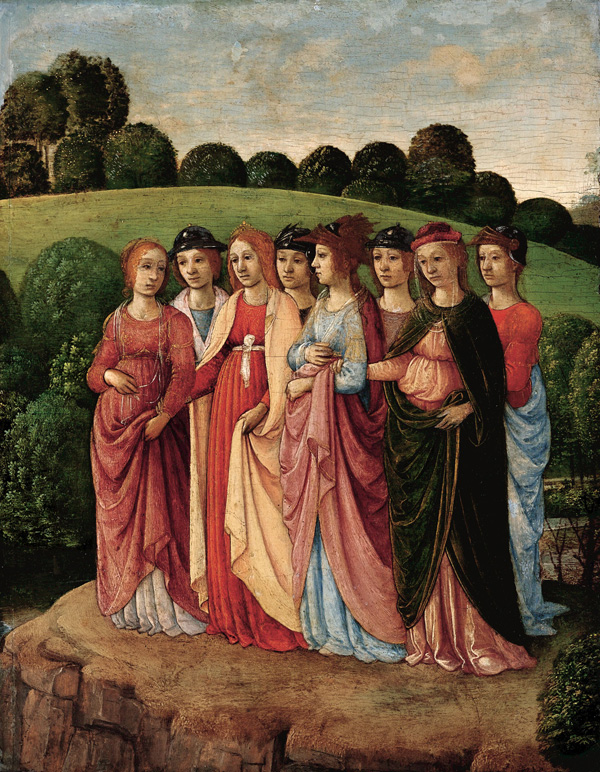
| Chaste Women in a Landscape, 1480's by Gherardo di Giovanni del Fora |
There can be little doubt that Anne Boleyn, like any expectant mother of her day, would have had deep concerns and perhaps fears as the days approached her expected delivery date. To add to her anxiety, Anne had a special worry. Though she seemed confident enough, and even boasted publicly, Anne might have harboured a secret fear. Would the child in her belly be a boy?
The importance of the gender of her awaited child cannot be underestimated. By time of the birth of Elizabeth, Henry had lost some of his ardent infatuation with Anne Boleyn. Finally married, new tensions and dynamics were arising in Anne and Henry's relationship. The king was now using a different tone with his queen. Worse, during the later months of Anne's pregnancy, Henry had a brief affair. It seems that much of the court knew about the affair, with some of Henry's men having actively promoted it to spite the hated new queen. Anne was openly jealous, and Henry found it very annoying. Catherine had only rarely opposed him, and Henry was unacquainted with such aggression in a queen--especially his queen. What he may have viewed as an attractive feisty edge when Anne was his sweetheart, was now viewed as shrewish behaviour coming from his wife. Anne had lost the allure of having been the unattainable sweetheart. Now, as the two settled into the daily monotony of marriage, Henry's feelings toward his new queen were changing. Expectations were changing. Henry was not young and idealistic, as he had been the first time around with Catherine, a whole lifetime ahead of him. Henry was in his 40's, and knew from experience how small the window actually was in which healthy pregnancy and childbirth were most likely. Henry knew that only a few years existed in this window, and that time was of the essence. To add to the mix, there were also endless miseries between Henry and Anne and the Lady Mary. Henry demanded that Mary show the respect due his wife, and his daughter flatly refused him. Mary was simmering with resentment toward Anne especially. Initially, Anne had made a few attempts to invite Mary to court, if she was willing to demonstrate a satisfactory level of respect due Anne as queen.
![]() |
| "I know of no other Queen of England, save my mother. " --Mary Tudor |
Still, even with other problems settling into the new marriage, Anne's first pregnancy was mostly a time of elation for the couple. It seemed that love was rekindled while Anne and Henry awaited the birth of their first child. It was a time of gaiety, and happy planning. Anne was given sumptuous accommodations, and a very valuable bed was presented for her delivery. However--Henry was expecting a son. And thus, his euphoria was not simply based on Anne's pregnancy. What really mattered was that Anne would present Henry with a son. Finally having the woman he had once been deliriously in love with was not nearly enough by that point. Anne had promised Henry during their courtship that she would be the mother of a prince, preferably princes, and not merely a "useless daughter,"as Catherine of Aragon had been. (Catherine had given birth to a baby boy; he would only live for a few weeks.)
It is perplexing as to why Anne was so certain that she would give her king sons. Almost since the inception of their relationship, Anne had carried herself with a haughtiness that is quite astonishing. Astonishing in the fact that for all the love and attention Henry showered on his sweetheart, he was still married. And most of his subjects would not forget for a second that their king was still married to their beloved queen, while carrying on an open affair with Anne Boleyn. Catherine had come to England as a rosy adorable youth, and the English people had fallen in love with the petite smiling girl. Her years as queen had only increased the love and loyalty the English people held for Catherine. Many of Henry's subjects were infuriated with his rejection of their queen, and many were surprisingly bold about their feelings. Though the king would severely punish some of those who openly opposed him, the hatred directed toward Anne took its toll on the couple. Anne had been so outspoken in her response, (perhaps hurt,) she had adopted an stunning new motto, which she displayed Christmas 1530. Ainsi sera, groigne qui groigne translated to: That is how it is going to be, however much people may grumble. It was a provocative slogan, and it did little to warm the people toward the new queen. The new motto and attitude was the polar opposite of Catherine's presentation of humble submission. (Of course Catherine was not always humble, nor submissive, but she did defer to Henry when and wherever possible.) The disparity between the two queens was not lost on the English people, and it inflamed their dislike of Anne Boleyn.
Though Anne had often flaunted a proud, and sometimes outrageous attitude, motherhood was an entirely different and new frontier for her. And surely the intelligent queen must have known that simply willing her body to produce a son was not a sure way to achieve the hoped for result. And yet Anne did carry on as though she knew she carried a prince in her belly. Had she thought that following the advice and rituals of divining women would give her the desired outcome? Perhaps she believed that she would be the 'blessed' queen, and as her reward Anne would be the mother of the king's son. Even Henry's former mistress Bessie Blount was given a good degree of honour and reward for delivering a son. Henry Fitzroy was only a bastard, but he was a boy. Bessie Blount would have received no such special privileges, such as her new title as Mother of the King's Son, if she had borne a daughter.
The diviners and astrologers who visited the king and queen assured them that Anne carried a son. Whether they were sincere in their predictions, or just behaving like any other sycophant who wanted to flatter the king is impossible to say. Henry's own expensive personal physicians had also assured him that Anne carried a prince. It does seem that Henry was confidant his second queen would give him the son he had waited for all those years. Perhaps he could not abide even the thought that Anne would give him a another daughter. A son would be a wonderful reward for the miserable years of battle with Catherine and the church, over the divorce. It would have made up for all the frustrating years of delays before Henry and Anne could be married. Yes, a boy would have made all the difference in the world as far as the king was concerned.
On 26 August Anne entered her time of confinement. On 7 September 1533 Anne's labour pains began. One attendant reported that the labour and delivery had been an extremely painful one. But at the end of it, Anne gave birth to a healthy baby. The child with the signature Tudor red locks was born at three o'clock in the afternoon. The new royal child was said to be beautiful. But it was not the son promised by the astrologers, diviners and physicians. Anne's new baby was a girl. Henry was the father of a second daughter.
Anne was very disappointed; Henry was angry. The mood of the birthing chamber can only be imagined. Finally, the king would pay his queen and new daughter a visit. Henry commented that they were both still "young," and that "boys would follow." Actually, both comments were overly ambitious, and in time would prove to be entirely incorrect. Henry was certainly not "young," at that point. And relative to the age she lived in, Anne was no longer what could be described as youthful. Tudor lifespans were short; and a woman in her 30's was considered past the bloom of youth. The marriage had been postponed for years, and unfortunately Anne was past the optimal age for childbearing. This would be proven, for after Elizabeth's birth, Anne would never deliver a viable child again.
Though Princess Elizabeth was given a beautiful Christening, and the king did warm up to Anne again sometime after the birth, the disappointment in the birth seems to have left a permanent tear in the fabric of the relationship. Elizabeth's birth was perhaps the beginning of the end of her parent's marriage.
09 January 2013
Out Goes Anne: In Comes Jane
Such was the case of Anne Boleyn.
When the tide began to turn against Anne Boleyn, it must have seemed to her that only a short time had passed from that when she was the object of Henry's adoration. Anne had been the young sweetheart, full of promise, contrasting Henry's unwanted wife. Now it was Anne that stood in that unenviable position; now she was the rejected wife, desperately clinging to her husband. Anne had aged visibly in her remaining last years, and was now described by Eustace Chapuys as a "thin and old" creature. And just like Catherine, Anne had been unable to give Henry the sons she had promised him. She had borne her husband a girl, one who would one day become Gloriana*, but in those bleak days, and in Henry's eyes especially, Anne had given him a useless girl. The idea of a 'useless girl,' is most detestable. However, the Tudor monarchs viewed the birth of a daughter almost as a punishment. Pity the poor royal wife who proved unable to provide male heirs. The woman bore full blame for this failing, as though she had knowingly and willingly chosen to withhold sons from her husband.
Anne was now walking in Catherine's old shoes, and finding the experience to be most miserable. Far from her days as the Most Happy, Anne was living in a state of misery and dread. Anne had been cruel and gloating toward Queen Catherine, and had been exceptionally unkind to Mary. Still, it is difficult to withhold sympathy from Anne Boleyn, as her sufferings were so marked.
Jane Seymour was now the king's sweetheart, the fresh new damsel that Henry was basing his hopes upon. She also served as one of Anne's ladies in waiting, and Jane's daily presence must have been excruciating for Anne.
Despite Anne's previous guilt and malice toward Catherine and her daughter, it didn't stop her from reacting with uncontrolled fury when Jane Seymour began to take her place. There is the famous story that Anne had ripped a locket from Jane's neck with such force that it sliced through her own fingers. Whether that report is true or not, Jane Dormer said there were frequent outbursts of physical violence "between the queen and her maid." Shockingly, Anne had frequently struck and/or scratched Jane. If this is true, Anne had sunk to a low point, indeed. (Interestingly, her daughter, Queen Elizabeth I, often resorted to vicious physical violence when one of her ladies angered her enough.) Given Anne's well-documented propensity for aggressive arguing, and how she managed to occasionally alienate her own blood relatives, the idea that she physically battered a woman who was actively courting her own husband may not be so hard to believe.
Historically, Jane has been portrayed as a passive paragon of womanly virtue. The bare facts, however, somewhat collide with that popular view of Henry's third queen.
Jane Seymour was known as an upright sort of woman. And the lady was quite proud of her 'goodly reputation,' and pointed it out, albeit in a clever way, when she modestly refused a purse of money the king tried to give her while they were courting. At least, this is how Jane was perceived, as a good woman, before her involvement with King Henry. She did not have the propensity for arguing, nor did she possess the foul temper that Anne Boleyn was noted for. Still, it must be remembered that Jane was actively involved with a still-very-married-man. Moreover, she was likely complicit in the horrifying downfall of Anne Boleyn. Chapuys, who had never been a fan of Anne Boleyn, and would have been more objective, described Jane Seymour as being very haughty. At the very least, Jane Seymour watched with a chilling passivity as her mistress inched closer and closer to the scaffold. Soon Anne would die, dispatched by a hired Calais swordsman. Anne's body would have hardly been cold in an arrow chest when Jane took up her place as queen. Henry's new love stepped right into Anne's place with scarcely a glance behind her. It seems that as soon as Henry heard the sound of the Tower guns marking the end of Anne's life, he and Jane proceeded with their new lives together as though Anne had never existed. Little Elizabeth was all but entirely forgotten. Lady Bryant was forced to practically beg Cromwell for funds to pay for a desperately needed new wardrobe for the little girl. But now that Elizabeth was branded a bastard, as Mary had been before her, her clothing was of little importance to the king. Elizabeth was almost hidden away, apparently out of sight--out of mind. Given what we know about Henry, his callousness is hardly surprising. It is Jane, as former mistress to Anne Boleyn, and a woman, that might give one pause.
Henry's court seemed to rejoice and believe that the good old days had returned, (or at least they pretended to). Privately though, many of Henry's subjects were appalled at how quickly Anne had been erased, and by the haste of the king's marriage to Jane Seymour.
But any hope of the golden days, if they had ever been such, was not to be realized. Though the king's new queen would conceive a child, dark clouds were looming over the kingdom. There were the ever-present political and religious problems, and of special concern was the plague. The plague was posing a horrible threat to the English people, and Queen Jane was developing a awful phobia of the dreaded sickness. Every precaution was taken but nothing seemed to calm Jane's fears of the plague.
Was it only the plague that was tormenting Jane, or was she afraid of more than that? Were the memories of her former mistress, and the manner of her cruel death haunting the new queen? Was Jane afraid of the age-old fear of dying in childbirth?
Tragically, Queen Jane's worst fears would be realised. For soon she would follow her former mistress, Anne Boleyn, to the grave.
*Elizabeth I would be called "Gloriana" by many of her subjects, as a term of endearment, respect and admiration.
08 January 2013
Mary Boleyn's Mysterious Relationship with Henry VIII
![]() |
| Mary Boleyn--Sister of Anne Boleyn Queen of England |
I've often wondered what the relationship between Mary and Anne Boleyn was like. These were two sisters, close in age, and both seriously involved with a king, though not at the same time, (fortunately.) For wouldn't such a tangled web create dramatic problems between two sisters!
And yet the two sisters each had shared a part of King Henry's life. Of course Anne was Henry's queen, mother to Elizabeth I. However, historians are not in agreement about Mary's exact relationship with Henry. She was a long term mistress. But Mary Boleyn may have been more than a mistress--she may have been mother to one, or even two of Henry's children. Were Catherine and Henry Carey the biological children of Henry VIII? Some historians believe this is unlikely; others believe the Carey children were in fact sired by the great king. Although it is a fascinating possibility, making a true determination of the parentage of the Carey children is difficult, to say the least. There is evidence which leads to opposite answers. Elizabeth favoured the Boleyn Family in looks, though not in colouring. Anne Boleyn's daughter had the fiery red hair of the Tudors. The colouring of the Carey children could suggest Tudor blood, but like Elizabeth, they too favoured their Boleyn ancestry. In fact, Elizabeth looked as though she could have been a full blooded sibling of the Carey children. Those had been strong genes, the traits that were carried by the Boleyn Family.
Back to Anne and Mary's relationship as sisters--they had not been close in later years. Did this have anything to do with Mary's previous involvement with the king? My thought is that this later distancing between the sisters was related to Mary's previous position as mistress to Anne's husband. That would cause at least a temporary rift between the closest of sisters, no doubt. And if Mary had borne the king's children, or child, there would be added complexities to an already delicate situation. For many different reasons, it would have been to Anne Boleyn's benefit to distance herself from Mary Boleyn and her children. A sad thing to consider, but probably one that Anne found positively necessary considering the bizarre triangle formed by herself, Mary and Henry.
George Boleyn seems to have favoured Anne over Mary, with George and Anne very close in the years before their deaths. Perhaps George and Anne had never been close to Mary.
Mary's first husband, William Carey, was a favourite at court. He was a member of the King's Privy Chamber, an Esquire of the Body to the King. Carey was an important man at court, and a rather handsome one at that. Of course, Mary would not have chosen William, even if he had been the husband she had hoped for. The match would have been arranged between the parents of the couple. And there seems to be evidence that the king approved, as he was in attendance at the wedding. This may be an ironic footnote, as Mary was later to become his mistress.
By the beginning of the involvement between Henry and Mary, Queen Catherine was prematurely aged, and had gained a significant amount of weight. François I cruelly famously described Catherine as "old and deformed." As well as being extremely distasteful, Francis' comments were very unfair. Catherine was ahead of Henry in age, by over half a decade, and her body had taken a beating. To add to the disparity, Catherine was old for her age, physically and emotionally. At this point in his life, Henry was the opposite, vibrantly healthy, almost supernaturally strong. Catherine had never enjoyed very good health, and over the years she had been pregnant time and again, exacerbating her frail constitution. Though perpetually pregnant, save for Mary, these all ended in disappointment. The queen tended to have miscarriages, stillbirths, or weak infants that would not survive for long. Catherine had also endured many painful hardships. She was widowed very young, then virtually stranded in a foreign country with an uncertain future. And though Catherine was finally married to Henry who she loved dearly, he had caused her not a few heartaches. If Catherine was looking worse for the wear, it can hardly be surprising.
Though Mary was Henry's mistress for what seems to be a fairly significant period, she would never make much of an impression on the English court. Mary simply did not have the verve, charisma, the enchanting dynamic to her person that her sister, Anne would have. Mary may have been beautiful, and the likelihood is that she was. As king, and at the time a young and very handsome king, Henry would have had his pick of many beautiful women. Henry had Elizabeth Blount as his mistress, and by him she had borne Henry's son, Henry Fitzroy. Elizabeth Blount was generally regarded as a stunning beauty by the male courtiers. Not only was Blount gorgeous, she was graced with talent and charm to spare. That relationship had lasted at least four years. Given these factors, it would probably take an exceptional beauty to engage King Henry, and Mary likely fit the part. However beautiful she may have been, Mary lacked Anne's dazzling feminine mystique. In fact, it seems that once Anne made her grand début at the English court, and in Henry's heart, she would leave the memory of Mary in the dust.
If Mary's children were in fact Henry's children, it was still not enough ,apparently, to even approach Anne's effect on Henry. And of course, Mary Boleyn was married. It is likely that Mary did not expect much from her time as mistress, and it seems she was right to assume the relationship would fade into nothingness.
Information on Mary Boleyn is rather scarce. If you would like to read more about this elusive Tudor lady, I highly recommend two fine works for you:
Wilkinson, Josephine: Mary Boleyn (Stroud, 2009).
&
Weir, Alison: Mary Boleyn (Ballantine Books, 2011).
Both books are non-fiction biographies on Mary Boleyn, exhaustively researched, and absolutely fascinating!
![]() |
| William Carey--First husband of Mary Boleyn |
![]() |
| Henry Carey--Son of Mary Boleyn |
![]() |
| Catherine Carey--Daughter of Mary Boleyn |
07 January 2013
Catherine of Aragon Dies: 7 January 1536
On this day 7 January 1536, Catherine of Aragon Queen of England would die, and pass into eternity. She was the first queen of King Henry VIII, and the mother of Queen Mary I of England. Queen Catherine was the daughter of Ferdinand and Isabella of Spain.
Even as her earthly life left her, minute by minute, Catherine was thinking of the man she still considered to be her husband. Catherine gave Henry her full forgiveness for all the agony he had inflicted on her, and prayed for him. She worried for Henry's spiritual well-being even as her death was imminent. Henry had inflicted emotional torment on Catherine for years by the time of her death, and his treatment of the wife of his youth had shocked the world. Catherine had been separated from her only living child, Mary, for several years prior to her death. This caused the queen untold anguish. Never having enjoyed very good health, there is little doubt that Catherine's sufferings contributed to her early death. Catherine died at Kimbolton Castle. Kimbolton was a desolate place, a cold, unhealthy habitation far from those she loved most. And those Catherine loved most had been, and would always be her husband Henry, and her adored daughter Mary.
After Catherine's death, some feared she might have been poisoned at the command of Anne Boleyn. Catherine's attendants reported that she drank a large draft of Welsh beer and had declined almost immediately after consuming the drink. Poisoning is extremely unlikely, and largely dismissed by most historians.
Catherine had been sick a long time prior to her death at Kimbolton. Initially, her last illness was not a cause for any unusual concern. Chapuys had been worried about Catherine's health, but her doctor reported that she was relatively stable. However, on 29 December the same doctor would send Chapuys a frightening message: Catherine had relapsed and Chapuys should head for Kimbolton as soon as possible. Henry again declined a begging request from Chapuys to allow Mary to visit her mother. Upon his arrival, Chapuys would find Maria de Salinas, one of Catherine's oldest and most dearest friends, at Catherine's bedside. She had devised a method of visiting the queen. Maria de Salinas (Lady Willoughby) was determined to be with her former mistress in her time of sickness. Maria would find Catherine desperately ill. Catherine was in an extremely weak state, and had been unable to eat or drink for days. Maria provided comfort and loving care to the queen, and Catherine's health would improve somewhat, though very briefly. After a few days, Chapuys felt confident enough to set back for London.
Catherine was troubled in her mind and heart those last days. She worried and wondered aloud if she had blame in the incredible events that had followed Henry's petition for a divorce. Were any of the miserable consequences of the huge rift her fault? Had Catherine been wrong, she wondered, to stand so steadfastly against Henry?
On 6 January, Catherine had been able to sit up, and even arranged her own hair. However, by evening Catherine was growing restless. By midnight Catherine knew she was imminently near death. She dictated a letter to Henry giving instruction on how to proceed with her goods, and asking that she be buried in the chapel of the Observant Friars.
With death approaching, Catherine prayed, asking pardon for her soul. By two o'clock in the afternoon of 7 January 1536, Catherine of Aragon had taken her last breath. She was 50 years old at the time of her death.
Moonlight...by Victoria Sackville-West
Moonlight
WHAT time the meanest brick and stone
Take on a beauty not their own
And past the flaw of builded wood
Shines the intention whole and good,
And all the little homes of man
Rise to a dimmer, nobler span;
When colour's absence gives escape
To the deeper spirit of the shape
--Then earth's great architecture swells
Among her mountains and her fells
Under the moon to amplitude
Massive and primitive and rude:
--Then do the clouds like silver flags
Stream out above the tattered crags,
And black and silver all the coast
Marshalls its hunched and rocky host,
And headlands striding sombrely
Buttress the land against the sea
--The darkened land, the brightening wave--
And moonlight slants through Merlin's cave.
By Victoria Sackville-West
06 January 2013
Margaret Beaufort: Mother to King Henry VII
In our current age any physician would be aghast at such early motherhood; but the Tudor royal marriages were dynastic. People were certainly more fatalistic, and death in childbirth was no stranger to any family. Everyone knew someone, or was related to someone who had died in the birthing bed. It seems the fear of early childbearing, in Tudor days, was that a woman would permanently lose her figure if she bore children at such a young age. It may be possible that Margaret did sustain some injury, since she was married a total of 4 times, and never again bore a child after her son Henry.
Margaret Beaufort was an exceptionally pious woman, and her son Henry had a great respect for her. Margaret rose from bed at midnight to attend the Matins of the friars. She spent mornings in her chapel, and typically wore a St. Francis habit beneath her robes. Margaret kept a yearly Maundy, a practice which Catherine of Aragon would imitate. This was the old custom of royal persons washing the feet of the poor, and after this distributing a purse of money to those unfortunates. (Anne Boleyn would also keep the practice of the Maundy. And some recipients noted that she was more generous in her distribution than had been Queen Catherine.)
For generations thereafter, Margaret Beaufort Countess of Richmond would be considered a fine example of piety, and of a new tradition of learning and study for women.
Subscribe to:
Posts (Atom)